Sponsored by Gruening Health & Wealth

McCarty in for treasurer

WTAX 93.9FM/1240AM

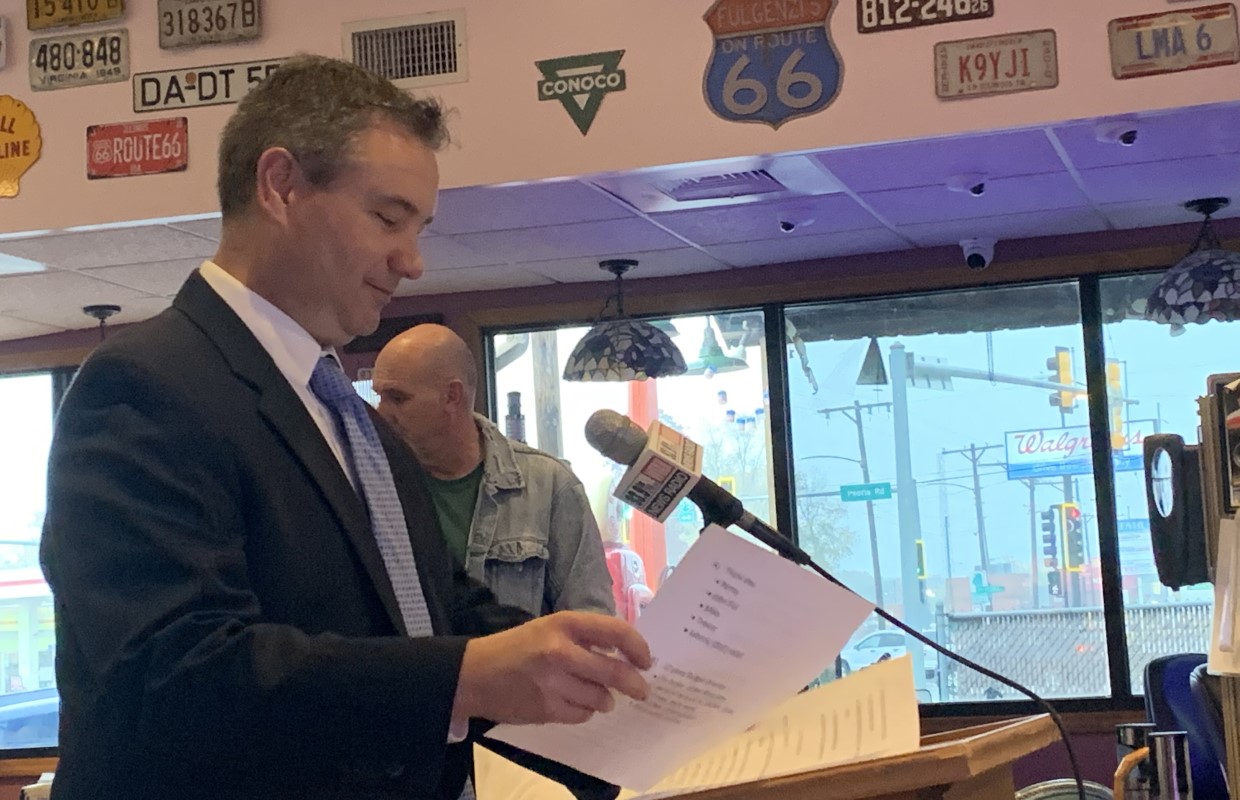
The newest candidate for Springfield city treasurer says the opening is an unexpected one. Bill McCarty is the city budget director and the third candidate to announce.

“This is a race that I expect and intend to win,” said McCarty, a onetime Williamsville mayor. “This is a race that I am well positioned for. It’s a race that i have been getting ready for for now over twelve years, so, certainly, I have experience, and I look forward to using that experience to help me in this race.”

The job comes open because incumbent Misty Buscher is running for mayor. McCarty says there is nothing like being accountable to the voters.

Deputy treasurer Colleen Redpath Feger and park board trustee Lisa Badger have already announced for next spring’s city election.

Election Day

clipart.com

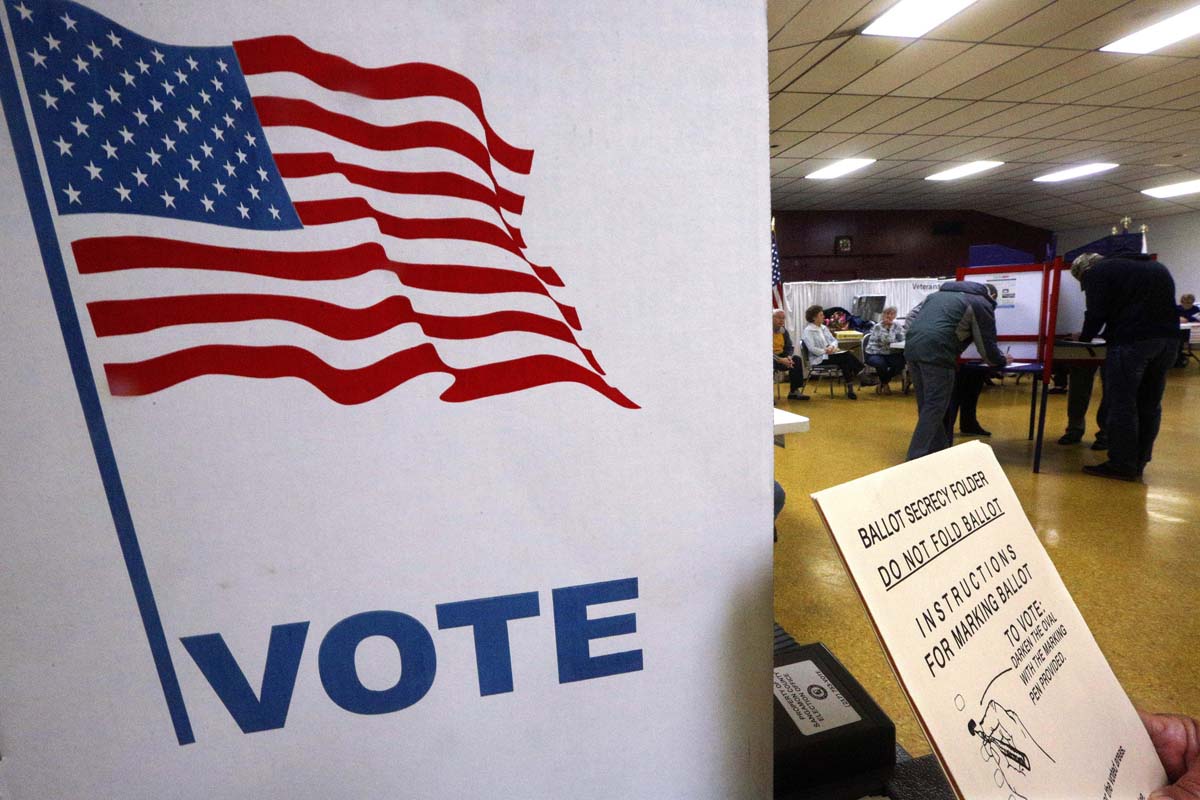
The primary election is here, with polls open until 7 p.m.

Races include multiple candidates for the 13th and 15th Congressional districts, as well as some Illinois House and Senate seats.

Highlighting the action is the Republican primary for governor, with the winner among six candidates earning the right to face incumbent Democrat JB Pritzker in November.

WTAX will have results on the radio during and after tonight’s St Louis Cardinal game as well as on www.wtax.com.

Fatal shooting in Decatur

WTAX 93.9FM/1240AM

A homicide investigation is underway following  a Christmas Eve shooting in Decatur.

According to our news partners at WAND T.V., at approximately 1:25 p.m. Friday, Decatur Police Department responded to the 500 block of S. Church St. where officers found a 31-year-old  Decatur resident with gunshot wounds.

The man was pronounced dead at the scene.

No arrests have been made at this time. The investigation is ongoing. Anyone with information is asked to contact the Decatur Police Department or Crimestoppers.

Spotlight on adult ed

Shutterstock

It is still true: you need more than a high school education to get ahead.

That’s what Jennifer Foster says. She is deputy executive director of the Illinois Community College Board, which received an update Friday about adult education programs, ahead of Adult Education and Family Literacy Week.

She says one million Illinois adults lack a high school diploma or GED.

“We are trying to work toward getting those folks a credential and then moving them forward to getting skills necessary for them to obtain those family-sustaining wages.”

Foster says the ICCB oversees 74 regional centers as part of the network of community colleges.


Fans allowed back in Busch Stadium

WTAX 93.9FM/1240AM

The St. Louis Cardinals have received approval to welcome fans back to Busch Stadium for the 2021 season, just in time for their home opener.

“We are excited to have our fans back in the stands for the upcoming season,” said Bill DeWitt III, team president. “We thank Mayor Lyda Krewson’s office, Health Director Dr. Fredrick Echols, and the City of St. Louis Health Department for partnering with us to develop a comprehensive reopening plan that complies with all City health directives and the League’s Return-to-Play Protocols.”

According to our newspartners at WAND TV Fans will be able to fill the stadium up to 32% of its actual capacity. The stadium holds 46,000 seats, which means only 14,720 tickets will be available per game.

According to the Cardinal organization, tickets for April home games will be on sale soon, and season ticket holders will get the first opportunity to get tickets for the first two games.

If seats are still available, ticket on-sale dates for the general public will be determined and announced at a later date.

Several protocols have been set in place to ensure the health and safety of fans, employees, and players, including:

Socially-distanced seating: Guests will be seated in pods of four or less with a minimum distance of 6-feet between seating pods in all directions.

Masks required: Masks will be required at all times in all areas of the stadium, including the seating bowl unless guests are actively eating and drinking.

Mobile-only ticketing: All game tickets will be delivered via the MLB Ballpark app, ensuring a touchless entry into the ballpark.

Cashless transactions: Concession stands, kiosks, and other
retail transactions made in the stadium will be cashless and only offer credit and debit payment options. Debit cards will be available for purchase using cash with no service fees at a limited number of locations inside the stadium.

Designated entry gates: Guests will be directed to enter and exit the stadium through one of six designated entry gates to expedite the process and limit crowding at any one entrance. A designated entry gate will be noted on each ticket. Guests will not be permitted to exit and re-enter the stadium.

Bags not permitted: To reduce contamination and ensure touchless entry, bags will not be permitted to be brought in to Busch Stadium, except for medical or diaper bags.

Hand sanitizer: Hand sanitizer dispensers will be widely available throughout the ballpark.

Staff health screenings: All full-time employees and event staff will be subject to health and temperature screenings before entering the stadium.

Additional changes will be implemented to ticketing, concessions, and retail operations to further reduce touch points among staff and guests, the release stated.

“Busch Stadium’s vast open-air footprint, six entry gates, and wide concourses gives us the ability to create the safest environment possible for guests to root on the Cardinals this year,” said Matt Gifford, vice president of stadium operations. “We’ve all missed the fans at the ballpark and are confident that all fans will adhere to these policies for an outstanding game day experience.”

In other efforts, Busch Stadium has also updated its HVAC systems by replacing filters in the ballpark to MERV 13 to ensure cleaner air in any enclosed spaces.

The organization said it will “continuously evaluate all guidelines, seek guidance from local and Major League Baseball health experts, and adjust policies or protocols as necessary.”

DIRT announces meth bust.

WTAX 93.9FM/1240AM

The Sangamon County Sheriff’s Office DIRT team arrested 24 y/o Calvin L. Drew, of the 100 block of East Oak, Springfield on November 13, 2020, at 11:35 a.m.

Dirt conducted a buy-bust operation on Drew, where they purchased approximately 30 grams of suspected methamphetamine from Drew. After the purchase, Drew was stopped by Sangamon County Sheriff’s Deputies and was taken into custody without incident.

Deputies recovered $660 USC, which was used to make the purchase. Drew was transported to the Sangamon County Jail where he is charged with Manufacture/Delivery of Methamphetamine, 15-100 grams, a Class X felony

Burglary at Toronto Rd. Head West Subs

A safe and cash register were missing after an overnight burglary at Head West Sub Stop in the 1200 block of Toronto Road.

According to the SJ-R a delivery driver found the business’ front door glass shattered around 4:50 this morning. It appears someone used a landscape rock to break open the door.

Springfield Police found no one in the restaurant after responding to the call.

The missing safe and cash register contained an unknown amount of currency.

Police are reviewing video from businesses in the area.

New online tool to track Chicago gun suspects draws fire

After a recent bloody weekend in Chicago, the city’s top police officer reiterated something he’s said many times in recent months: People accused of gun-related offenses are too quickly and easily getting back on the street.

This time, Superintendent Eddie Johnson unveiled a new online tool aimed at illustrating his point by giving the public a quick way to see who’s been arrested on gun-related charges and whether they have posted bail.

“If we’re OK with how things are going, then don’t look at it,” Johnson said as he announced the Gun Offender Dashboard. “But if you want to know why we are suffering from some of the things we are, then take a look at it and come to your own conclusions.”

The tool is part of a public relations offensive to draw attention to what Johnson and Mayor Lori Lightfoot say is a cause of gun violence in Chicago, where more people are fatally shot than in any other city in the U.S.

But critics decry it as a scare tactic that lumps people arrested while carrying or even standing near a gun with those who have pulled them out and used them. They say it unfairly maligns people who under the law are presumed innocent and is aimed at pressuring judges into keeping people locked up while they await trial.

“The people on this list have not been convicted of the crimes for which they were charged,” Cook County Public Defender Amy Campanelli said in a written statement. “Yet CPD is flaunting bond court stats as if they have already been convicted.”

“Even sex offenders have to be found guilty in a court of law before we put them on a public registry labeling them as sex offenders,” added Era Laudermilk, a top Campanelli deputy.

The dispute over the tool stems from a larger disagreement over changes to Cook County’s bail system. To ensure people don’t languish in jail while waiting for trial, the county’s chief judge, Timothy Evans, two years ago implemented a policy that requires judges to set affordable bail amounts for those not deemed a danger to the community.

By all accounts, the policy has had a dramatic effect. Today, 1,500 fewer are people in the county’s jail.

Suburban police criticize Foxx on Smollett case

Suburban Chicago police associations have added their criticism to how the Cook County state’s attorney handled charges against “Empire” actor Jussie Smollett that accused him of staging a racist, anti-gay attack.Three groups representing police chiefs voted to express “no confidence” in Kim Foxx. Several police chiefs were set to attend a joint news conference with Chicago police union leaders later Thursday.

Foxx recused herself before Smollett was charged. But she defended a decision by her office last week to drop all 16 felony counts against Smollett, saying money was better spent on more serious crimes.

A letter from the North Suburban Chiefs of Police saying Foxx displayed a tendency to not pursue prosecutions of lower-level felonies.

Foxx’s office told WLS the criticism was “an excuse to justify” wider resistance to “prioritizing resources to increase public safety and reduce harm.”

Sangamon County Declares Level 1 Winter Weather Emergency

Sangamon County has declared a Level 1 Winter Weather Emergency, in effect at 8:00 p.m. this evening until further notice.  The declaration applies only to county highways.  Under a Level 1 Winter Weather Emergency, roadways are open, but considered hazardous.  Drivers will encounter blowing and drifting snow and should use extreme caution.

Road conditions will be monitored throughout the evening.  If necessary, the emergency level may be adjusted based upon those changing conditions. The media will be notified of any changes.  In addition, motorists are encouraged to access the Sangamon County Website (www.co.sangamon.il.us) and click on the quick link “Winter Weather County Highway Road Condition Map” to see the latest driving conditions on Sangamon County highways.  Given the large geographic size of Sangamon County, not all areas of the county may be experiencing the same winter weather conditions.  The map can provide more localized conditions, especially as the roads are treated and cleared.

BACKGROUND: The Sangamon County Board has established a three level system as outlined below with the intention of more accurately defining what a winter weather emergency means;

LEVEL 1: Roadways are hazardous. Drivers may encounter blowing and drifting snow and roadways may be icy. Drivers should use caution.

LEVEL 2: Roadways are hazardous with blowing and drifting snow and may be icy. There are areas where the roadways may be partially closed by the elements. Travel on County Highways is discouraged. No one should be out during these conditions unless it is absolutely necessary to travel. Emergency personnel may not be able to respond in a timely manner if you are stranded.

LEVEL 3: Weather conditions have fully closed the County Highways. No one should be out during these conditions. Emergency personnel will not be able to respond in a timely manner if you are stranded.

The Chairman of the Sangamon County Board shall make the declaration of the Winter Weather Emergency Level after consulting with the Sangamon County Sheriff’s Office, the Sangamon County Office of Emergency Management, the Sangamon County Highway Department and others departments or agencies if necessary.

IMPORTANT REMINDER:  Abandoned vehicles on County Highways that obstruct public safety and road clearing operations are subject to towing and ticketing by the County.  If your vehicle becomes disabled on the roadway, please notify Sangamon County Central Dispatch at 753-6666.  You should be prepared to provide your license plate number, vehicle description, vehicle location and a call back number.  This is especially important if you abandon your vehicle.  In addition, by notifying central dispatch of an abandoned vehicle, emergency crews will know that a motorist is safe if they come upon their vehicle.

Over 250 new laws ring in the New Year.

Illinois lawmakers completed the state’s 100th General Assembly in its bicentennial year, and will ring in 2019 with 253 new laws on the books .

The youngest children in cars will be required to ride in rear-facing seats, blaze pink will be acceptable for hunters’ wardrobes, opioid abuse and school safety take center stage and a Route 66 centennial planning commission will convene.

Here’s a look :

CHILD RESTRAINT AND TRAFFIC SAFETY

Children younger than two must ride in rear-facing child-restraint seats in automobiles. Children taller than 40 inches or weighing more than 40 pounds are exempt.

The first offense carries a $75 fine at the discretion of local authorities.

Rescue vehicles in Chicago will be required to use sirens and lamps only when “reasonably necessary to warn pedestrians and other drivers” of their approach.

The law also tasks the secretary of state with updating the “Rules of the Road” with information on the “Dutch Reach” method of opening car doors. While sitting in the driver’s seat at the curb, the Dutch Reach involves reaching across the body with the right hand to open the door, thereby encouraging a glance over the shoulder at oncoming traffic.

Backup vehicular lights will be required to emit a white or amber light without a glare.

100 YEARS OF 66 KICKS

Route 66, the storied “Mother Road” that connected Chicago to Santa Monica, California in one of the nation’s earliest interstate highways, turns 100 in 2026. A commission to celebrate its centennial begins work.

FIREARMS

A 72-hour waiting period for purchases of firearms takes effect after a year of scuffling over gun restrictions in the wake of continued mass shootings.

Legislative Democrats wanted to impose a 72-hour waiting period on assault-style weapons, similar to the one in place for handguns. Republican Gov. Bruce Rauner decided consistency demanded a 72-hour waiting period for all guns.

Another law will allow family members or police to petition courts to take guns away from people who pose a danger to themselves or others. A judge may issue the order without notice but a hearing must be conducted within 14 days.

OPIOID EPIDEMIC

Those with licenses to prescribe opioids must complete three hours of continuing education on safe opioid-use practices before renewing their prescription licenses.

Another law bars insurance and managed-care companies from requiring prior notification for specified in- or outpatient substance-abuse treatment in order to get those with drug-use disorders the help they need quickly.

The state’s Division of Alcoholism and Substance Abuse, part of the Department of Human Services, will be renamed the Division of Substance Use Prevention and Recovery, and the law governing it will be rewritten to better reflect the priority given to the opioid-abuse epidemic. The aim is to provide clearer guidelines for medical and community-based organizations that provide intervention and treatment, and for insurance companies to adopt a standardized approach to such care.

MILITARY VETERANS

Veterans and active duty military service members who are believed to have physical or mental health problems may now be considered “high risk” if they go missing.

Health-care facilities will have to provide a free copy of a homeless veteran’s medical records when requested by the veteran or an authorized agent for the purpose of supporting a veteran’s claim for disability benefits.

HUNTERS

Blaze pink joins blaze orange as acceptable hunting apparel to ensure that sportsmen and -women are seen by other hunters.

PUBLIC SAFETY

Every school in Illinois must conduct at least one active-shooter safety drill administered by local police annually.

Carnival operators must conduct criminal background checks on every ride operator they employ. A background check was previously required but state officials had no capacity to revoke a violator’s permit.

Stalking laws will expand to include unwanted messages sent through social media apps. And the law allows businesses, churches and other places of worship, and schools to seek restraining orders against stalkers.

The Department of Corrections will be required to collect and report violence in prisons and publish public-safety reports. They’ll include numbers of assaults, sexual assaults, contraband, weapons, suicide and segregation.

RIGHTS AT WORK, ELSEWHERE

If the boss requires you to use your personal phone or computer for work, the boss must have a reimbursement policy.

The Equal Pay Act expands to prohibit employer discrimination by paying African American employees at rates less than non-African American workers.

And in an expansion of #MeToo anti-sexual harassment protections, any company wishing to do business with the state must have policies on addressing sexual harassment complaints. The same is true for companies participating in the EDGE job-creation tax-credit program.

Another law allows nursing mothers to be excused from jury duty at their request.

No smoke alarm in fatal garage fire.

Authorities say there was no working smoke detector inside the building where a 51-year-old Springfield man died following a fire.

Garyl J. Gauch of Springfield died early Wednesday, shortly after a postal worker called to report a garage on fire.

Firefighters found Gauch while searching the burning building. He was later pronounced dead at a hospital.

Fire Marshal Chris Richmond said the detached garage had been converted into a two-bedroom apartment and Gauch had been renting the apartment for more than 10 years.

Richmond says the cause of the fire is under investigation. He says the residence didn’t have a working smoke alarm, despite an Illinois law requiring landlords provide smoke alarms in inhabited structures.

It’s unclear if one wasn’t provided or if it was removed.

Hurricane Michael: Mt. Zion paramedic

Hurricane Michael relief efforts involve a paramedic who traveled to Florida as part of an emergency response team.

This story from our news partners at WAND TV.

Trevor Smith, a man from Mt. Zion, is part of the Disaster Medical Assistance Team (DMAT), which is a division of the National Disaster Medical System (NDMS). The U.S. Department of Health and Human Services’ Office of the Assistant Secretary for Preparedness and Response (ASPR) organized help for the areas that took heavy damage from the hurricane in Florida.

“ASPR moved about 400 medical and public health personnel, along with their caches of medical equipment, into impacted areas,” NDMS Acting Director Ron Miller said. “Most of our DMAT personnel are augmenting medical care at overwhelmed emergency departments in the Florida Panhandle. Other medical personnel are coordinating with Urban Search and Rescue teams to triage people rescued or are providing basic medical care for evacuees at shelters.

NDMS leaders say they will continue to help in Florida as long as the state needs them. Teams sent to the area have helped more than 1,300 patients as of Wednesday.

The government sent NDMS workers from across the country to Florida in the aftermath of the storm. In total, the NDMS organization includes about 5,000 professionals who can assist people and pets. They’re organized into over 70 response teams.

Hurricane Michael killed at least 16 people in Florida and another 10 or more in other parts of the southern U.S.

Data: 116 state jobs moved to Springfield in last 2 years

SPRINGFIELD, Ill. (AP) — A Springfield-area lawmaker who wants to bring more state jobs to the Illinois capital city says new data show more work needs to be done on the effort.

New numbers from the Department of Central Management Services show that 116 state jobs moved into Springfield from other parts of the state since Gov. Bruce Rauner took office in 2015. However the agency says more than 400 state jobs were lost in Sangamon County during the same time period.

Republican state Rep. Sara Wojcicki Jimenez of Leland Grove sponsored a resolution asking state agencies to report on where jobs were located and why they couldn’t be in Springfield. The survey was sparked by the belief that former administrations moved hundreds of state jobs out of Springfield.


Chatham Police looking for Discount Tobacco burglar

Chatham Police are looking for information about a burglary of the Discount Tobacco on Main Street in Chatham on July 23rd. Just after 11pm, an unknown person smashed a window to gain entry to the business and stole several cartons of Newport cigarettes and the cash register.

Images of the suspect were caught on surveillance video. The suspect was wearing black shoes with white trim on the bottom and light colored blue jeans with a pattern on the back pockets, and a dark hoodie over his shirt to conceal his identity.

Anyone with information about who was responsible for this burglary can earn a cash reward of up to $2500 for a tip that leads to an arrest. Call the Crime Stopper tip line at 788-8427, or you can leave a tip anonymously on the website: http://www.cashfortips.us

Rauner celebrates small business

Even though he eschews caffeine, Gov. Bruce Rauner found something to purchase — root beer — at a roastery and coffee bar near the Capitol Monday. It was to celebrate Small Business Week, something Rauner admitted is not easy, given governmental regulations and restrictions. Rauner has talked quite a bit these days about the red tape that he says is choking off business in the state.

“Some business are able to weather through the regulations, the thicket of restrictions,” Rauner said after making a proclamation. “Basically, we haven’t created any net new jobs in Illinois in seventeen years.”

The off-topic questions during a brief session with reporters included one about the 36 improperly hired “staff assistants” for IDOT from when Pat Quinn was governor.

“We have got to stop this culture of cronyism and patronage, and we are doing everything we can.” When a reporter asked if Rauner’s office interviewed former staffers of Comptroller Leslie Munger – an incumbent who lost the election in November – before putting them on his team, the governor said, “Our team, I think, did a very good job of evaluating which folks to bring into our administration. We want people who are very talented and very capable of providing high value for our taxpayers.”

Separately, the governor has activated the State Emergency Operations Center to monitor reports of flooding from the weekend rains. “I have been monitoring this,” he said at the coffee shop. “I’ll probably be traveling around the state in the coming days, reviewing the damage and making sure we are providing the support services to the communities that have been hard hit.”

Senators predict Grand Bargain will go on

After a break, it’s likely Illinois Senate President John Cullerton (D-Chicago) and Minority Leader Christine Radogno (R-Woodridge) will resume talking about their 12- or 13-bill Grand Bargain.

Things hit the skids Wednesday when Democrats called some of the bills for votes over Radogno’s objection. “Our caucus wanted everything nailed down before we called the first bills,” Radogno told reporters after the votes. “That request was not honored, and that was reflected in the (Republicans’ Present and No) votes. We are still on track. We can always re-vote on the pension bill which went down. Obviously, they need our help on that one. We’re prepared to deliver that significant pension reform.”

On the other side of the chamber, Cullerton said the way the votes came down on four bills is not discouraging. “No – just the opposite! We only called one bill that was contentious. I got eighteen votes for it. That’s eighteen votes with the unions opposed to a pension reform bill. (Radogno) can easily get twelve (Republican) votes for the pension reform bill, see? So that was very helpful.”

Three non-controversial bills passed with all Democratic votes.

There’s optimism in Illinois

Expect an optimistic, forward-thinking Gov. Bruce Rauner – halfway through his first term and two years away from facing voters again – when he takes the podium for his third State of the State address at noon Wednesday.

You can hear WTAX’ coverage of the State of the State message, including interviews with local lawmakers afterward, at noon on Newsradio 1240 and 93.5 FM and on wtax.com.

The governor has tipped his hand on some of his talking points via his Twitter account, @GovRauner, with the hashtag #StateoftheState

Excerpts from his prepared remarks:

“Clearly we’re excited about the achievements we’ve made and the opportunities left to seize.  But we still face significant challenges.”

“Through bipartisan cooperation, Illinois can once again be the economic engine of the Midwest and the home of innovation and prosperity.”

“We – Republicans, Democrats, and everyone in between – have a moral obligation to work together to bring change. We, together, can return Illinois to a place of hope, opportunity, and prosperity.”

Even Democrats are hoping for the best. “Hopefully, he’ll talk about trying to work on a bipartisan basis to help us get out of this,” said State Sen. Heather Steans (D-Chicago), talking about the state’s budget stalemate. She says the Senate is putting together a possible solution – thirteen bills which make up a Grand Bargain. “I’m hoping we’re making some real progress on that, and I’m hoping he can get on board and support it.”

Rauner has, for the most part, been mum on the package, which features an increase in the income tax rate to 4.99 percent from the current 3.75 and some changes to pensions and workers’ compensation.

The last time the governor of Illinois signed a full-year, full-service budget, the year was 2014, and the governor was Pat Quinn. State Rep. Steve Andersson (R-Geneva) suggests that’s not entirely fair to point out.

“A lot of times, change is hard. A lot of times, change takes time,” Andersson said. “To suggest simply that because Gov. Quinn was able to put his name on a budget means that this (current strategy of Rauner) isn’t the right path, I think, is a misstatement. What we need to be able to do is get to a real budget — that’s sustainable and grows the state.”

“He’s running a failed administration with no hope for the future until he himself decides to govern,” spits State Rep. Lou Lang (D-Skokie), no fan, predicting the high points Rauner will cite today are “mini-accomplishments” completed only with Democratic help.

Greater Springfield Chamber Of Commerce Celebrates Volunteers

The Greater Springfield Chamber of Commerce recently held their annual gala to celebrate what its head says is all of the great things being done around the community and to also celebrate all of the volunteers they have. Chris Hembrough, President and CEO  says the Chamber has an “Ambassadors Committee” of 25 people which was formed to be a membership committee to keep members informed, recruit new members, help retain membership to help them decide whether or not it’s their strategy to be a member.

Hembrough said the Chamber has many goals that they’re going to continue to work on this year. They include generating more land for local businesses, getting residental housing in the downtown area, and working with the Mid Illinois Medical District on redisigning their website.

Kewanee Braces for What’s Next

While prison reform supporters say the announced closure of a juvenile detention center is a good step to addressing Illinois’ corrections problems, leaders in Kewanee expect to feel it from multiple directions.

Friday’s announced closure of the Illinois Department of Juvenile Justice facility in Kewanee was applauded by prison reform groups as a positive step in reforming Illinois’ juvenile system, but Kewanee Mayor Steve Looney says he’s still trying to absorb the announcement.

“Until we get a final resolution,” Looney paused, “it’ just a huge impact now.”

Looney said he was called by a state senator the evening before the announcement.

Lynn Sutton, a Henry County board member and Chairman of the county Economic Development Partnership, was notified of the announcement when the media called for comment. Sutton said a closure would work against their plan for growth.

“With established goals to, over the next five years, increase jobs by a thousand, alright,” the closure will be a blow to the county economy.

Kewanee City Manager Gary Bradley said with the slated closure for this summer it’s still unclear what will happen.

“If it’s mothballed it will be a big impact,” Bradley said, “if we can get another use for it, it will mitigate that.”

Bradley also said the closure will impact more than just the economy, there could also be a brain drain.

Because many of the jobs at the IDJJ facility require a bachelor’s degree Bradley said “with that gone, that will have a negative impact on the demographics of our workforce.”

“Those employees are our friends, our family, our neighbors, and it will be difficult for them,” Bradley said.

Mayor Looney also had concerns about the affected employees. “You know we care about them as individuals and as citizens of Kewanee,” Looney said.

There are around 200 employees expected to be affected by the planned closure slated for this summer.

The ACLU says the closure is a positive step in addressing concerns from a consent decree about juvenile justice reform.

More Jousting from U.S. Senate Dem Hopefuls

U.S. Senate candidate Andrea Zopp is making criminal justice issues the focus of her campaign, while criticizing one of her primary opponents for “playing it safe.”

In a speech to the City Club of Chicago Wednesday, Zopp outlined her plans for policing reform, citing her experience as an Assistant U.S. Attorney and as former president of the Chicago Urban League as reasons why she’d address issues raised by police-involved shootings more effectively than her primary opponents.

“The roots of the divide between law enforcement and communities of color are embedded in the racial issues that often separate us,” Zopp said.”We cannot move forward if we do not understand where we have been.”

Zopp’s specific plans include passing a federal law which “bans racial profiling in all contexts” within law enforcement. She also called for requiring state’s attorneys around the country to publicly report statistics on shootings involving police officers annually.

While Zopp didn’t mention one of her primary opponents, State Sen. Napoleon Harris (D-Harvey), she did criticize the frontrunner in the race, U.S. Rep. Tammy Duckworth (D-Hoffman Estates) for not supporting the Iran nuclear deal as quickly as she did. “Congresswoman Duckworth could actually have made a difference because who she was and who she is, and chose not to,” Zopp said. “We don’t have time for safe politics anymore.”

Duckworth’s campaign manager Matt McGrath responded by saying, “Her comments are misguided and unfortunate, and betray the frustrations of a candidate and campaign that hasn’t managed to break through or meet expectations. Tammy’s record of public service, careful deliberation of national security issues, and defending her country speaks for itself.”

Harris’ campaign didn’t return a request for comment.

Duckworth has the current advantage in fundraising in the primary race. She raised $1.6 million in the final quarter of 2015, while Zopp raised $314,000. Harris’ fundraising numbers weren’t reported, as he only declared his candidacy in November.

The three candidates are set to meet in a televised debate next month.

Another Idea for Recall

Recall elections would be allowed throughout local and state government under a new proposed constitutional amendment.

Momentum has been building behind an effort to allow Chicago’s mayor to be recalled. State Rep. Mark Batinick’s (R-Plainfield) proposal aims to establish recall statewide, from statewide offices like Attorney General and Comptroller to state legislators to elected officials in local government.

“I think if we’re going to pass recall bill for local officials, it’d be pretty hypocritical not to have those same sort of powers for ourselves,” Batinick said.

The amendment would also change the current requirements to recall the governor, eliminating the need for state legislators, equally split between the political parties, to support a recall before petitions can be circulated.

“I think the key thing is that this is citizen driven,” Batinick said.

Batinick had proposed a more limited recall bill last year which would have applied only to local governments in non-home rule communities around the state. He says that was due to a fear that state lawmakers from Chicago would oppose any effort to allow recall elections for the city’s elected officials.

“Obviously, there’s been a little bit more of a call for a recall with the city legislators,” Batinick said.
In order to enact this expanded form of recall, the proposal would need a three-fifths vote in both the House and Senate, and then gain the support of 60 percent of those voting on the issue in the next election.

Bobcat Season Is Coming

Bobcats are no longer endangered, and a newly signed bill aims to curtail what some downstate lawmakers say is a rapidly growing population.

Bobcats were endangered in Illinois from 1977 to 1999, but their numbers have recovered. Samantha Hagio of the Humane Society of the United States is worried a bobcat hunting season will endanger the animals once again.

“Nobody really knows how many bobcats are in Illinois,” Hagio says. “The last thing we want to do is initiate a hunt before we know how many bobcats are in the state, using the same methods that led to their demise in the first place.”

The measure barely passed the house – it got 60 votes, the minimum number required. Bobcat season will run from November 1st to February 15th, hunters will be allowed to kill one animal per season for a fee of no more than $5.

Can You Shop Smarter?

If you’re on a tight budget, you can probably learn to shop more efficiently at the grocery store.

Jenny Epstein runs the Healthy Lifestyles Initiative for Ever Thrive Illinois. It’s a statewide effort, aimed primarily at low-income people who might be on food stamps, to teach good shopping and eating habits. She says they give supermarket tours across the state, and more extensive lessons.

“In addition to the Cooking Matters at the Store tour, we also do six-week-long Cooking Matters courses. It’s a six-week program where we do a nutrition and culinary education component, and we show people that with a few basic ingredients, some fresh fruits and vegetables, some spices, you can make a delicious meal that’s low in fat, low in sodium, low in sugar and low in cost,” she said.

The lessons are intended for low-income people but are applicable to anyone who wants to save money and eat better.

Basic advice in the store: Read labels, read unit prices, and buy the produce that’s in-season; it’ll be the cheapest.

www.ilmaternal.org/cookingmatters/index.html

Many Start College, Not Enough Finish

In a world in which two-thirds of the jobs require a four-year degree, barely 40 percent of Illinois workers have one. That’s not enough.

“We can’t get there by simply focusing on the ‘traditional’ college student,” says Jim Applegate, executive director of the Illinois Board of Higher Education. “If you drop to the third quartile, which is still middle class, barely one out of three had a four-year college degree, and if you go to the low-income quartile, barely one out of ten has a four-year college degree. We have been failing a large group of students.”

Applegate, promoting “The Four Year Myth,” a project of Complete College America, says much of the blame lies with colleges in not properly advising and guiding students. He says the course catalog on many campuses is as big as a King James Bible, and many students have to fend for themselves to figure out which classes to take, how many to take, etc.

Applegate says other problems include not taking what’s considered a full load (15 credit hours per semester), taking the wrong courses, staying “undeclared” or “undecided” after their freshman year, and dropping out with little to show for their efforts.

Click to access 4-Year-Myth.pdf

Lawmakers Encourage Tech and Innovation

People who promote technology in Illinois are celebrating the creation of a “Technology and Innovation Caucus” in the state legislature.

Some of these caucuses are more formal and more serious than others. For example, there’s an African-American caucus. And there’s a White Sox caucus.

This one may be closer to serious than frivolous, looking into business-minded legislation.

“We have insight from various technology companies that are in Illinois, or that are planning on moving (some offices) to Illinois,” says co-chair State Sen. Mike Hastings (D-Tinley Park), citing “companies like Apple, AT&T, Google, Motorola Mobility, (which) provide feedback, and then we talk about legislation that could affect it in positive ways or in negative ways.”

The best thing about it, says Hastings, is that it’s bipartisan.

University of Illinois Names New President

A new president is on his way in at the University of Illinois.

The U. of I. announced Wednesday that it’ll be Timothy L. Killeen, coming here from the State University of New York, where he was vice chancellor for research and president of the Research Foundation.

He said in his remarks this morning after being introduced at the University of Illinois at Chicago that the world is a technological place, put people are most important.

“By focusing on human capital, and students, faculty and staff, higher education can partner with other sectors, and also create the needed social capital and economic capital for our common future,” he said. “Where else can all these ingredients come together than in a place like this?”

Board of Trustees Chairman Christopher Kennedy said the search committee and the board were looking for a new president who has experience teaching and administration, whose research is substantial enough to impress the faculty, and who has experience in the workings of government and other grant-making organizations.

Killeen spent 20 years on faculty and in the administration at the University of Michigan, and is a former assistant director of geosciences at the National Science Foundation, which distributes federal research funds, and the U. of I. is third among universities in getting those grants.

He still needs official Board of Trustees approval, expected to come Jan. 15, and then he’ll take over when Robert Easter retires in the middle of next year.

Merger Idea for State’s Financial Offices Is Back

The candidates for state treasurer agree the office should be merged with the office of comptroller, but they still disagree with each other.

Combining the two offices would supposedly save $12 million a year. State Rep. Republican Tom Cross (R-Oswego), the Republican nominee for treasurer, says it won’t happen without a strong push.

“You can’t be beating around the bush, you can’t nibble around the edges. You have to say this is important and we have to do it, and we’ve been that way and will continue to be that way,” he said.

State Sen. Mike Frerichs (D-Champaign), the Democratic candidate, is also for the idea, but Cross says Frerichs isn’t as willing as he is to expend political capital fighting for it.

Frerichs says if it’s done, it must be done properly. “You need to make sure there are internal controls in place. You need to make sure you have proper oversight. But as the only candidate in this race who has experience managing a financial office (he was Champaign County auditor), I say we need to make sure we do it right, and if we do it right, we can have savings, and it’s something I’ll support,” he said.

This would entail a constitutional amendment. The Senate passed a measure to put that on the ballot, with Frerichs voting yes, but it was not considered in the House.

Oberweis: Term Limits Are Good for POTUS, Why Not Everyone Else?

Republican U.S. Senate candidate Jim Oberweis continues to talk term limits for members of Congress.

It was an idea that was tried 20 years ago: Republicans running for Congress in 1994 promised it, and when they won a majority, they called for a vote a constitutional amendment limiting senators to two sex-year terms, and House members to six two-year terms. The vote
was 227-204 in favor, short of the 290 needed to amend the Constitution. Three other term limits bills failed to get 200 votes. In 1995, the U.S. Supreme Court ruled in the Thornton case that term limits imposed on members of Congress by state law could not be enforced.

Yet the issue remains popular with the public, and Oberweis talks about it in his stump speech. “I worked hard for state limits in Springfield, and I will take that idea to Washington, although it is going to be incredibly difficult to make it happen. But for heaven’s sake
if eight years is good enough for the president of the United States, why isn’t eight years good enough for Congress?” he said.

Oberweis uses the issue to whack U.S. Sen. Dick Durbin (D-Ill.), who is running for a fourth term, but he says there are Republicans who’ve been in the Senate too long too. “Absolutely. I think eight years is enough for Congress. Two terms (12 years) is enough for the U.S.
Senate,” he said.

Seventeen senators have more seniority than Durbin, and seven are tied with him. Of those 24 senators, 13 are Democrats and 11 are Republicans.

Durbin is against term limits,saying that for some politicians, 30 years isn’t long enough, and for some two years is too much.


Oberweis is a Republican state senator from Sugar Grove.

Oberweis Courts Black Vote

U.S. Senate candidate Jim Oberweis is following other Illinois Republicans in courting African-American voters—and his supporters say it’s the Democrats who are playing in the race card in this election.

One of Oberweis’ supporters in the African-American community, Pastor Corey Brooks of Chicago’s New Beginnings Church, claims the accusation that he and other pastors are being given money in exchange for backing Republicans is racist.

“We are not a novelty, and we are not slaves,” Brooks said.

Oberweis says he’s garnering support because he’s been out in these communities, something he claims Democrats haven’t been.

“The Democrats have taken the African-American community votes for granted, and the Republicans have ignored ‘em, thinking we don’t have a chance to get those votes,” Oberweis said. “We’re saying that period is over.”

Oberweis is opening a campaign office across the street from Brooks’ church, which is his first office in a predominantly African-American neighborhood.

CO Detectors Are Not Required in Schools

More than 100 people – most of them children – were sickened when carbon monoxide leaked from a faulty water heater flue at North Mac Intermediate School in Girard on Monday.

Only a few people were hospitalized for observation, and the North Mac school district then installed carbon monoxide detectors. It’s not the law.

“There’s a very substantial health life safety code in the state of Illinois,” says Ben Schwarm, “where school buildings go through a more rigorous assessment of their safety features than most any other buildings.:

Schwarm is deputy executive director of the Illinois Association of School Boards and says unfunded mandates are unpopular. He says if there is a bill which comes through, he would favor finding money already available.

Meanwhile, he says, as North Mac has now done, districts are free to install detectors if they want to.

Blood Center Opens New Lab, Administrative Center

The Central Illinois Community Blood Center has a new laboratory and administration building on the south end of the city.

After cutting the ribbon Wednesday, CEO David Parsons says the facility at Stanford and 10th Streets will make  operations more efficient by giving employees more elbow room.

“We can now perform the functions for the Blood Center in a much better space, a much bigger space.  We’ve given our staff some class areas to work in'” says Parsons.  When talking about the current blood donor facility, Parsons says there are no immediate plans.  “We are undecided. Are we going to remodel or perhaps relocate it somewhere else?”

Blood donations will still take place at its facility on South 7th Street.  The Blood Center serves 14 hospitals throughout central Illinois.

Help Wanted: School District Looking for Cable TV Sponsors

The Springfield School District is looking for corporate sponsors to help underwrite its cable channel.

Springfield District 186 Superintendent Jennifer Gill says she is asking the community to step up to help the district continue broadcasting board meetings.

“It does have to be truly a sponorship.  You have to say you sponsor the public schools.  They can give a shout-out to a school but it cannot be an ad.  Their name will appear on the screen,” says Gill.

Gill says district employees rely on the broadcasts and their AV Coordinator is slated to be laid off as part of budget cuts.

Service Members Free at ALPLM

The Abraham Lincoln Presidential Library and Museum will offer free admission to military service members and their families this summer.

About 2,000 museums nationwide will do the same.

Illinois Historic Preservation Agency director Amy Martin says service members make sacrifices for the country and it’s an honor to offer them free admission.

Free admission for those who qualify will be from May 26 to Sept 1.

The library will also host parties to thank troops, which will include activities for children and Civil War re-enactors.

Service members must show a form of identification.


Old Farmington High School Burns

The former high school in the central Illinois city of Farmington has burned, sending a black plume of smoke into the sky that was visible for miles.

Yates City Fire Chief John McKinty says no one was injured in the Thursday morning fire, which sent flames shooting more than 20 feet through the roof. About a dozen fire departments helped fight the blaze for hours.

The building was the original Farmington High School and was built in 1925. It was turned into a commercial center when classes moved to the new high school building in 2004.

Farmington is in Fulton County, about 20 miles west of Peoria.

Local Student Headed to West Point

Another Springfield native is headed to a prestigous military academy and Jon Bluhm says his experience at Sacred-Heart Griffin will serve him well at West Point.

Bluhm is headed to West Point because of his grades and extra-curricular activities. His mother, Wendy, says she is thrilled but hesitant.

“Just like any boy, he always liked Army-type things and that type of stuff.  We will cope” says Bluhm.

Bluhm was sponsored by Congressman Rodney Davis and was presented his appointment letter during his English class Tuesday afternoon.  He says he has always hoped to serve his country.  Bluhm graduates from Sacred Heart-Griffin later this month.

City Video Gaming Expansion Limits Move Forward

The full city council will debate whether to limit the number of gamining licenses the city of Springfield issues next week.  Alderman Joe McMenamin says one firm is choking the market.

“Of the 89 establishments, six account for 20-percent for the wagings taking place.  These establishments were not really intended to receive gaming machines by the state legislature” McMenamin says.

The alderman says he will support an ordinance proposed by Alderman Cory Jobe that would make any new applicants for video gaming to show the establishment makes at least 60-percent of their revenue from food and beverage sales.

The city council could take up the measure May 6.

Sen. Murphy Tired of Hyperbole

Illinois Senate Republicans are criticizing the directors of state agencies for trying to make the case for extending the income tax increase.

“I refer to it the Parade of Horribles,”  says State Sen.. Matt Murphy (R-Palatine) (pictured), who says agency witnesses are describing the state’s financial condition in the most dire terms.  “They are cherry-picking every worst-case scenario possible to paint a picture of a huge hole that will be created if the tax increase goes away.”

He’s for more optimistic revenue estimates, and for agencies keeping funding the same as this year.

The tax increase is due to end this year, dropping the personal income tax rate from 5 percent to 3.75, but the governor wants to extend it. Revenue from the tax increase has largely gone to pension funds; the state’s operating budget has declined in recent years.

State Sen. Mike Connelly (R-Lisle) says that when agency witnesses are asked if they could persevere with the same budget next year as this, “they shrug their shoulders and generally say yeah, we probably could,” he said.

Allowing the tax to expire and not replacing it with any other source of revenue would cost the state $1.5 billion in Fiscal Year 2015 and $3.9 billion in Fiscal Year 2016, according to the Civic Federation.

The governor’s office says allowing the tax hikes to lapse would force budget cuts, including the layoff of 13,000 teachers, 21,000 senior citizens losing in-home care, 41,000 fewer children in child care and 30,000 fewer college students getting MAP scholarships.


Fuzzy Language in Law Could Draw University Employees to Retire Early

It’s the story of the reluctant retirees.

As a twist on the pension restructuring law which is now tied up in courts, a glitch in the bill effectively, university pension counselors say, forces faculty members to retire May 15 or forfeit significant benefits.

At a special meeting Friday, University of Illinois trustees and administrators got an earful.

“The course I prepared last fall for next fall won’t be taught by me,” said Tim Keiderling, a chemistry professor at the university’s Chicago campus. “The course that I teach every year to graduate students, that I’ve developed over twenty years, and is absolutely unique in our department, won’t be offered next year.”

“It’s a question about what’s prudent in the rest of my life,” said longtime College of Education professor Steve Tozer. “This is why you get the language from some of my colleagues who say, ‘I’m being forced to retire.’ There’s some level at which we’re not being forced to retire. The prudent decision is to retire and not take a significant hit” on one’s pension.

The trustees heard stories of star professors in their forties and fifties taking out-of-state job offers to continue their careers.

“I just want to apologize to the entire faculty for allowing this to get this far,” board of trustees chairman Chris Kennedy said, “for putting our entire university at risk, and putting the future of our state at risk, I apologize for that.”

The change affects employees at other public universities, too.

State Sen. Daniel Biss was involved in drafting the legislation and says the fix would be simple. But some lawmakers may be uneasy about reopening the pension legislation.

New Officers Join the SPD

Springfield Police Chief Kenny Winslow says the new officers sworn in for service Tuesday could be the best class he has seen and he looks forward to them hitting the streets after additional training.

“The challenges they are going to go through going forward are going to be very stringent, they are going to be tough but, they are going  to do a great job.  I am very excited about that” says Winslow.

The seven new officers are all men, two of them Hispanic.  Winslow hopes future classes will be more diverse, something the Houston administration has been pushing.

The officers will continue with field training for several more weeks before they will patrol on their own.

2013 Was a Win-Win-Win in Home Sales

2013 was a better than expected year for the Illinois housing market.

Springfield’s Phil Chiles, president of the Illinois Association of Realtors, says all the signs point to continued growth and recovery compared to the previous year. “The overall number of sales has gone up, price, the median price has gone up, days on the market has gone down,” Chiles said. “I mean, you put all those things together, it’s just been a very good year for most areas of Illinois.”

Year-end home sales were up 18.9 percent from 2012, and the median price rose 8 percent to $150,000. Chiles says growth may slow down in 2014 if interest rates go up higher than expected. On the plus side, he expects the number of foreclosed homes to dip to pre-recession levels by the end of the year.


Two Metro East Counties Are Again “Judicial Hellholes”

A business group is complaining again about the justice they get in some Illinois courtrooms.
Madison and Saint Clair counties are again “judicial hellholes,” and Cook County is on the watch list, according to the annual report by the American Tort Reform Association. Ed Murnane of the Illinois Civil Justice League says this is enemy territory when businesses are hauled into court.
“There are some situations in these three particular counties that happen to be particularly offensive to, I think, the concept of fairness,” he said.
In particular, he complains that asbestos litigation nationally is drawn to Madison County, even when neither the plaintiffs nor the defendants and their insurers are from there. He believes the public should elect judges more favorable to business interests, and one way to accomplish that would be to have them run in the non-partisan local elections, rather than as Democrats or Republicans in the November state elections.
But Stephen D. Phillips, president of the Illinois Trial Lawyers Association, notes that 70 percent of civil cases are filed by businesses. “Mr. Murnane’s financial backers have no qualms about going to court when they think their rights have been infringed upon,” he said.
Phillips says civil litigation in general (down 25 percent since 2007) and medical malpractice cases in particular (down 40 percent since 2003) have declined in recent years, and that is not necessarily a good thing. He says there are citizens who’ve been harmed who are unable to recover damages because of the cost and complexity of bringing litigation